Agentic Software Project Estimation
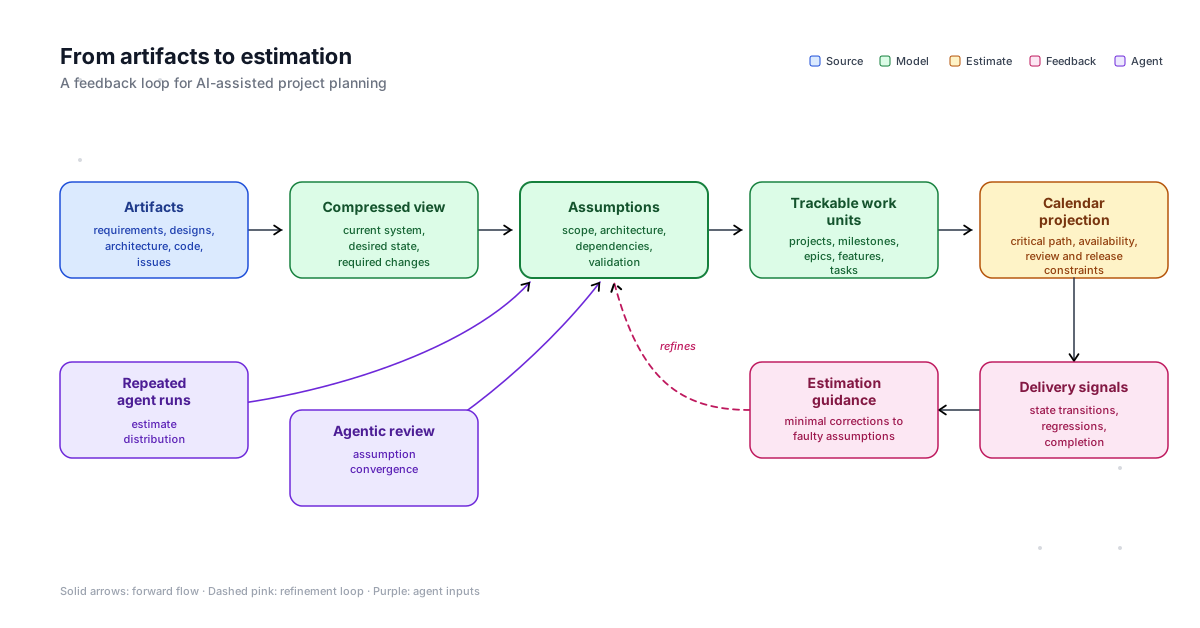
Software project estimation usually asks a practical question: how much work remains before a defined completion state is reached? Agentic workflows can improve the answer by making estimation assumptions explicit, attaching size estimates to trackable work units, projecting those estimates into calendar dates, and feeding delivery outcomes back into future estimation guidance. The central opportunity is not that agents can guess better than people. It is that agents can help make estimation more repeatable, inspectable, reviewable, and correctable in large organizations with complex requirements, legacy systems, and cross-team dependencies.
The Question Estimation Answers
Software project estimation should answer a practical question: how much work remains before a defined completion state is reached?
The completion state may be a production launch, an internal milestone, a customer acceptance condition, a compliance gate, or another state defined by the organization. The important point is that the estimate concerns remaining work, not an abstract amount of difficulty. A useful estimate describes the gap between the current state of the work and the state in which the organization considers the work complete.
This framing matters because large software projects are rarely estimated from a clean beginning. They usually exist inside an ongoing project-management system, a live product, a partially understood implementation, and an organization with established practices for tracking projects, milestones, epics, features, and tasks. Agentic estimation should therefore integrate with existing trackable units rather than replace them with a parallel planning system.
The output may be a range such as "six to nine weeks". That range should not be treated as a stylistic hedge. It should be the visible result of a set of explicit assumptions, size estimates attached to work units, dependency information, contributor availability, and a calendar projection derived from those inputs.
Estimating the Gap
The object being estimated is the gap between the current system and the desired completion state.
For small changes, the gap may be a simple extension of the current architecture. For large projects in mature organizations, the gap may include changes to foundational design, ownership boundaries, data models, release processes, operational practices, or assumptions embedded in old code. A serious estimation process must distinguish between extending the system as it exists and changing the system so that the new work can fit.
Agents can help because they can inspect product requirements, design documents, architectural notes, implementation artifacts, and project-management records. However, the goal is not to pour every available artifact into a context window. Large organizations contain too much information for that to be useful. The goal is to derive a compact, estimate-relevant description of the current system, the desired system, and the changes required to move from one to the other.
This compression step is central. If the abstraction is too detailed, estimation becomes analysis paralysis. If it is too vague, the estimate cannot be evaluated after delivery. The useful level is coarse enough to support planning and fine enough that wrong assumptions can later be identified.
Starting from Artifacts
An agentic estimation process should start from artifacts rather than memory or isolated opinion. The relevant artifacts may include product requirements, design documents, architecture proposals, existing implementation, test suites, project-management records, dependency maps, and prior estimation guidance.
These artifacts do not need to have a uniform form. In real organizations, requirements may live in documents, designs, issue threads, diagrams, source code, review comments, and informal decision records. The estimation process should tolerate that messiness while still producing a structured estimation artifact.
Existing implementation deserves special attention. Code can be projected back into a higher-level description of what the system currently does, which constraints it imposes, and which parts of the future work conflict with the current structure. For large legacy codebases, this current-system abstraction is mandatory. Without it, the estimate risks describing the desired product change while missing the system change required to make it possible.
The same principle applies recursively. A project estimate can be decomposed into milestone estimates. A milestone can be decomposed into epics, features, or tasks. Each level should use the organization's preferred units and only refine the decomposition while the added detail improves the signal-to-noise ratio.
Assumptions as the Core Artifact
The central primitive of agentic estimation is the assumption.
An assumption may be technical, product-related, organizational, procedural, or operational. It may concern architecture, scope, dependencies, CI/CD, manual validation, review latency, release constraints, staffing, or completion criteria. The category matters less than the fact that the assumption can be stated, inspected, and later compared with reality.
Risk can be understood through the same model. A risk is an assumption whose uncertainty or consequence deserves attention. Confidence is also downstream of assumptions. An estimate is more credible when its important assumptions are explicit, supported by appropriate artifacts, and historically well calibrated.
This changes the shape of estimation work. Instead of asking an agent to produce a number, the organization asks it to produce an estimate together with the assumptions that make the estimate defensible. Human judgment remains essential because foundational assumptions often require contextual evaluation. An agent can surface them, test them against artifacts, compare them with prior projects, and ask for clarification, but the organization must still decide whether they are acceptable.
Project-Management Integration
Agentic estimation should live inside, or at least closely beside, the project-management system.
The organization already has a way to represent projects, milestones, epics, features, tasks, dependencies, ownership, and state transitions. An estimation system should attach metadata to those units rather than invent a parallel structure. That metadata may include size estimates, assumption links, dependency links, review history, projected dates, actual transition dates, and references to the artifacts that justify the estimate.
The exact storage model is secondary. The metadata could live in a separate system, or it could be represented as issue types, custom fields, linked records, or generated project-management updates. What matters is that the estimation state is durable, cross-linked, and available for validation.
This integration also lets estimation and implementation remain connected. A decomposition produced during estimation can become, or link to, implementation work. The level of interactivity can vary. Some organizations may want proposed changes that require human acceptance. Others may allow tentative updates that are flagged for validation. The essential requirement is that estimate metadata can be traced to implementation changes and delivery state.
From Work Estimates to Calendar Dates
Calendar projection is not estimation. It is a derived calculation from estimation metadata.
The estimation process attaches size estimates to trackable work units and records the assumptions behind those estimates. A projection process can then map those units onto a calendar using dependency relationships, critical path analysis, contributor availability, review capacity, validation queues, CI/CD constraints, release constraints, and the organization's normal operating cadence.
This distinction is useful because it separates two different sources of error. The work estimate may be wrong because an assumption about the project was wrong. The calendar projection may be wrong because the scheduling model failed to represent dependencies, availability, or organizational throughput. Treating both as one opaque date makes the system harder to improve.
The range attached to a completion date should come from the uncertainty in the underlying assumptions and estimates. A projection of "six to nine weeks" is more useful than a single date when the width of the range reflects known uncertainty rather than arbitrary caution.
Agentic Variance and Review
Agents can be useful in estimation because they can run the same estimation process repeatedly.
Independent autonomous runs produce a distribution of estimates. The variance between runs is information. It may reveal ambiguous requirements, unstable decomposition, hidden dependencies, inconsistent interpretation of artifacts, or weak estimation guidance. A narrow distribution does not prove correctness, but a wide distribution tells the organization where the estimate is not yet stable.
Agentic review is a second mechanism. Agents can inspect estimation artifacts, challenge assumptions, compare decompositions, identify missing links, and revise the estimate until the remaining disagreement is smaller or better understood. The goal is not merely agreement on a date. The goal is a better assumption set and a lower-variance estimate whose remaining uncertainty is visible.
This can reduce individual bias and some psychological failure modes in estimation. It can also reduce analysis paralysis by making the stopping rule more explicit. The process stops not when everyone feels certain, but when further decomposition or review no longer improves the estimate enough to justify the cost.
Feedback from Delivery
The feedback loop is what makes agentic estimation more than a more elaborate way to guess.
Each estimate should be preserved over time. Scope changes, assumption changes, and delivery progress should produce new versions rather than overwrite the old record. Otherwise the organization cannot distinguish an inaccurate estimate from a project whose scope changed after the estimate was made.
Actual delivery creates signals. A work item starts, moves through states, regresses, waits, and eventually reaches its completion state. The projected completion date can be compared with those transitions. When the estimate is wrong, the important question is not only how large the error was. The important question is which assumption would have needed to be different to prevent the error.
The useful feedback is the minimal change to estimation guidance that would have prevented the faulty assumption. That guidance may apply at the project level, team level, group level, or organization level, depending on where the assumption came from. Over time, the system should become better at generating assumptions because previous faulty assumptions have been converted into improved estimation guidance.
Without this feedback loop, humans must keep correcting the system manually. The estimation process may still produce plausible artifacts, but they may not become useful enough to trust or maintain. The feedback loop is therefore not an optional analytics layer. It is part of the mechanism that makes the assumptions improve.
Feasibility
This model is realistic, but it is not a lightweight feature.
It requires agents that can inspect heterogeneous artifacts, derive compact descriptions of existing systems, reason about the gap between current and desired states, attach estimates to trackable work units, preserve assumption history, run repeated estimations, review estimation artifacts, and connect delivery outcomes back to estimation guidance.
It also requires organizational commitment. Teams must keep enough project-management state for the process to observe meaningful transitions. Estimation metadata must be preserved rather than overwritten. Humans must evaluate important assumptions. The organization must be willing to revise its estimation guidance when delivery data shows that an assumption pattern was faulty.
The promise is not automatic certainty. Software projects in large organizations remain complex because products, systems, and organizations are complex. The plausible improvement is a more rigorous estimation process: one where assumptions are explicit, estimates are reproducible, uncertainty is visible, calendar dates are derived rather than guessed, and errors become inputs to better future assumptions.